In traditional woodworking operations, a tape measure is an essential tool for every craftsman. However, with the rapid development of woodworking machinery and construction machinery, excessive reliance on manual measurement is not only inefficient but also error-prone. This article will explore how modern woodworking machinery can help manufacturers get rid of their dependence on tape measures and achieve more accurate and efficient production processes through digitalization and automation technologies.
From manual measurement to digital positioning: at the heart of technological evolution
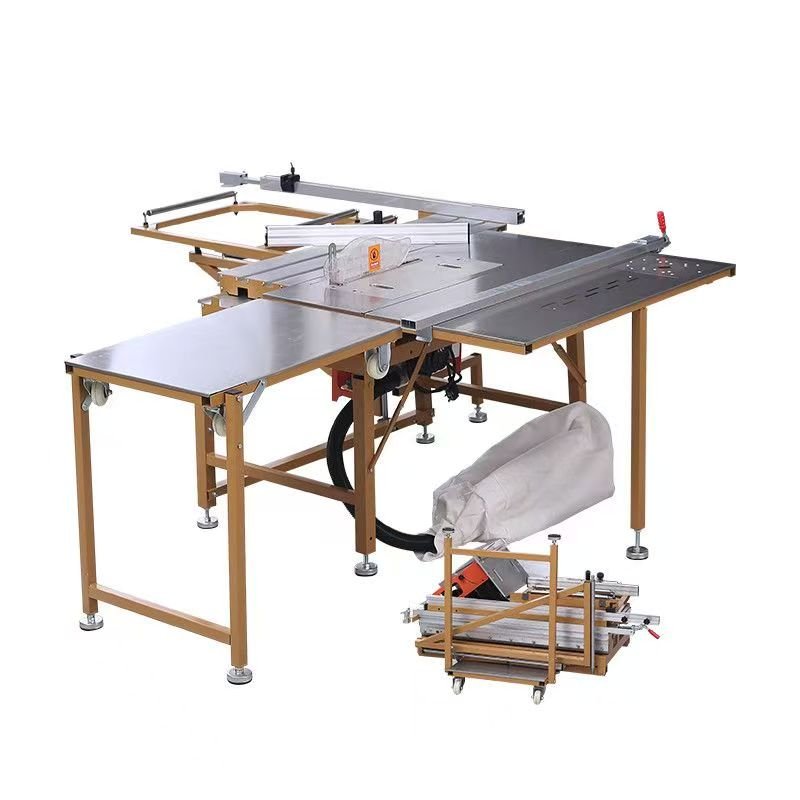
In traditional woodworking, craftsmen need to repeatedly measure, mark and check, which is not only time-consuming, but also human error is difficult to avoid. Modern woodworking machinery such as CNC panel saws, edging machines and machining centers have integrated high-precision sensors and digital positioning systems. These systems feed back position data in real time via a laser or encoder with an accuracy of ±0.1 mm, far beyond the limits of manual measurement. For example, advanced push table saws are equipped with digital displays and fine-tuning devices, the operator only needs to enter the dimensions, and the saw blade is automatically positioned, reducing the error in the measurement link.
Application Scenario: Efficiency Revolution of Mass Production and Customized Processing
In mass production, such as furniture manufacturing or building formwork processing, the use of woodworking machinery with automatic positioning can significantly increase efficiency. Take the CNC panel saw as an example, which is able to automatically cut sheets of different specifications according to a preset program, eliminating the need for every manual measurement, thus reducing the production cycle by more than 30%. In the field of construction machinery, such as wood shredders or sheet production lines, automatic measurement systems ensure consistent raw material dimensions and reduce waste. For customized machining, such as complex mortise and tenon structures, CNC machining centers directly generate tool paths through 3D modeling, completely replacing manual scribing and ensuring the accuracy of complex shapes.
Selection Suggestions: How to Select the Right Automated Measuring Equipment
When purchasing woodworking machinery, buyers should pay attention to the measurement and positioning system of the equipment. First of all, clarify the production requirements: if large batches of standard parts are the main, choose equipment with automatic feeding and positioning functions; If you focus on customization, you need to pay attention to the software compatibility and tool magazine capacity of the CNC system. Secondly, to evaluate the repeated positioning accuracy of the equipment, it is recommended to select a model with an accuracy within ±0.2 mm. In addition, consider the human-computer interaction interface of the device, whether it supports graphical programming to reduce the dependence on skilled workers. Finally, it is important to inspect the after-sales service of the manufacturer to ensure the timely replacement of key components such as sensors or encoders.
Data-driven: The inevitable trend from tape measuring to smart manufacturing
Modern woodworking machinery is not only a tool, but also a data acquisition terminal. Through the integration of IoT modules, the equipment can record processing parameters and output in real time, providing decision-making basis for plant managers. For example, the introduction of an automatic measurement system in a plate processing plant reduced the scrap rate from 5% to 1.5%, while saving 30% of measurement time. These data suggest that abandoning tape measures and embracing digital measurement is the key to improving competitiveness. For more information on smart woodworking equipment, visit our Product Center 。
sum up
The withdrawal of tape measure is not accidental, but the epitome of the transformation of woodworking industry to automation and intelligence. By adopting the precise positioning system of modern woodworking machinery, enterprises not only improve product quality, but also reduce labor costs. For buyers, investing in advanced measurement technology is investing in future production efficiency. For more industry updates, follow our NEWS 。